

New York Area Exoplanets Meeting
Important Information
New York Area Exoplanets seeks to connect astronomers in the greater New York area working in the field of exoplanet science (or related ventures) for a one day conference in NYC.
This year’s one-day meeting will be held on Friday, May 15th, 2026 and hosted by the American Museum of Natural History (AMNH).
We can accommodate ~ 130 attendees.
American Museum of Natural History
200 Central Park West
New York, New York 10024
There will be no registration fee to attend.
Abstracts will be due March 10, 2026, and the conference registration deadline will be April 15, 2026.
NOTE: We will be replacing poster presentations with 1 minute lightning talks.
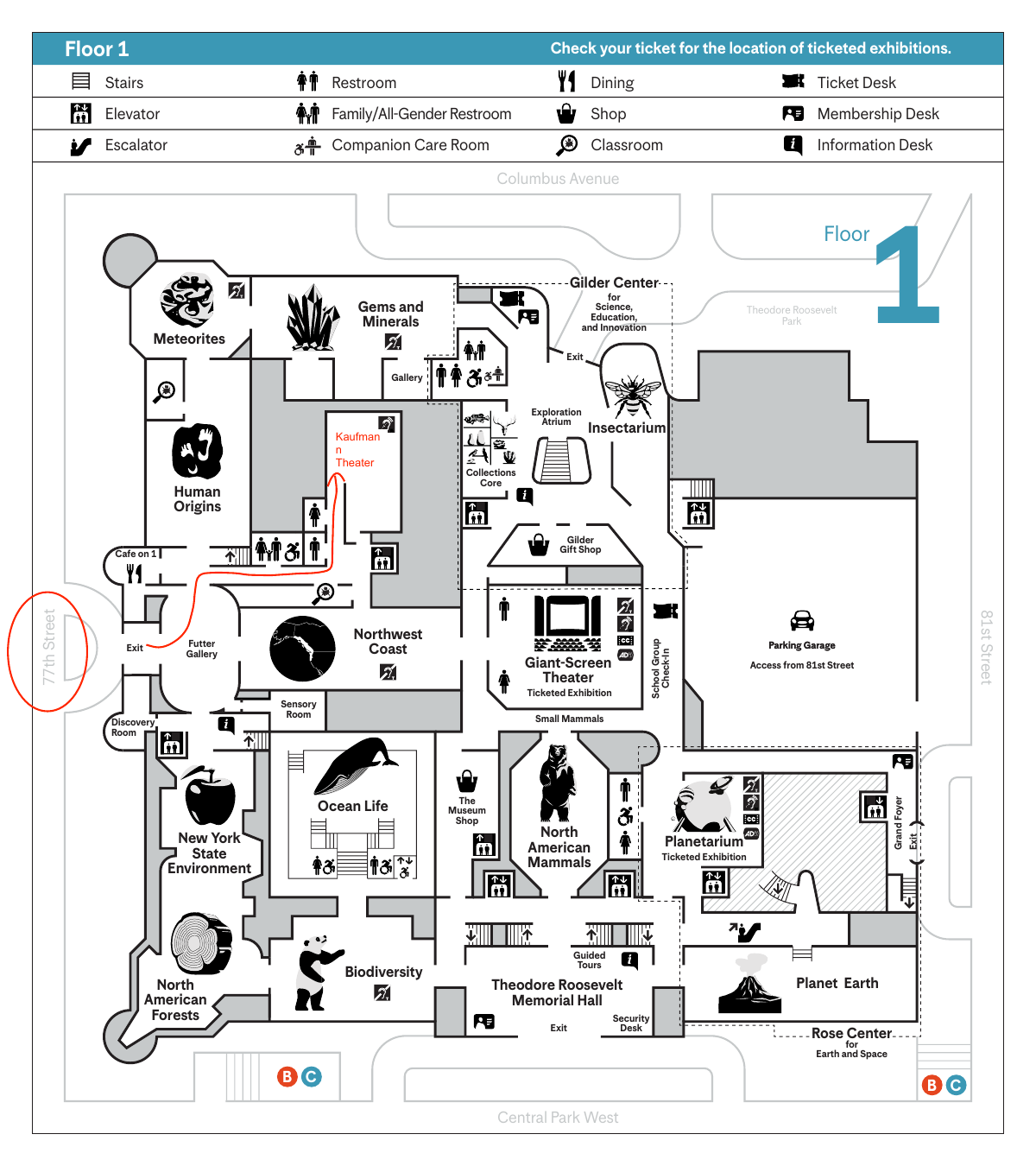
For those attending, please remember to bring photo ID to check in with the security desk upon arrival. Entrance to AMNH is located off Central Park West below the main staircase (see map below).
The dress code for this meeting is casual.
AMNH does not provide lunch. For your convenience, a map of nearby restaurants has been compiled.
-
SOC (Alphabetical)
- Phil Armitage (CCA/Stonybrook)
- Keaton Bell (CUNY)
- Emily Calamari (AMNH)
- Dax Feliz (CCA)
- Jane Huang (Columbia)
- Mordecai-Mark Mac Low (AMNH)
- Malena Rice (Yale)
- Niall Whiteford (AMNH)
- Josh Winn (Princeton)
Schedule
| Time | Speaker | Title | |
| 10:00 | Opening Remarks | Jane Huang, Malena Rice | |
| 10:10 | Session One | Chair: Dax Feliz | |
| 10:10 | Thomas Pfeil | How Dust Evolution Controls the Turbulence in Protoplanetary Disks | |
| 10:20 | Meredith Hughes | Dynamical Masses of Debris Disk Host Stars | |
| 10:30 | Yurou Liu | Hot-Jupiter-Hosting Binary Systems are Preferentially Eccentric | |
| 10:40 | Kostas Tsigaridis | Is Earth special? The role of planetary configuration on climate | |
| 10:50 | Jada Louison | Probing the Formation Mechanisms of Brown Dwarfs and Planetary-Mass Objects using Keck/LRIS | |
| 11:00 | David W. Hogg | Precision measurement considerations for exoplaneteers | |
| 11:10 | Nicholas D'Introno | Protoplanetary Disk Chemistry in Binary Systems | |
| 11:20 | Renata Wentzcovitch | New Mineral Physics for Super-Earth Mantles: Iron-Bearing Phases at Terapascal Pressures | |
| 11:30 | Brianna Zawadzki | Probing the Collisional Cascade in AU Mic with Resolved Vertical Structures at Multiple Wavelengths | |
| 11:40 | Tiger Lu | A Massive Companion to the Ultra-hot Jupiter KELT-20b Suggests Formation Inside the Water-ice Line | |
| 11:50 | 1-Min Lightning Talks | ||
| 12:00 | Lunch | ||
| 1:30 | Session Two | Chair: Emily Calamari | |
| 1:30 | Kate Follette | Fortuitous Discovery of Possible Disk Signatures Around a Planetary Mass Companion with JWST | |
| 1:40 | Niamh O'Sullivan | The Search for Supergranulation across Spectral Types | |
| 1:50 | Amir Siraj | Measuring the Dynamical Structure of the Distant Kuiper Belt | |
| 2:00 | Ayanna Mann | Multiwavelength Signatures of a Candidate Planetary Engulfment Event | |
| 2:10 | Ryan Butler | Unsafe for Children: Chandra Establishes the Hostile X-ray Environment of the Infant Transiting Exoplanet TIDYE-1b | |
| 2:20 | Aida Behmard | A Link Between Rocky Planet Density and Host Star Chemistry | |
| 02:30 | Nicholas Saunders | The Fate of Planets Orbiting Evolved Stars | |
| 02:40 | Genaro Suarez | Spectral Energy Distribution Analyzer (SEDA) for Modeling and Empirical Analysis of Ultracool Objects | |
| 2:50 | 1-Min Lightning Talks | ||
| 3:00 | Coffee Break | ||
| 03:30 | Session Three | Chair: Keaton Bell | |
| 03:30 | Madeline Maldonado Gutierrez | Evaluating Planet Vetting Robustness Across TESS Photometric Pipelines | |
| 03:40 | Zachary Langford | Order-by-order Modeling of Exoplanet Radial Velocity Data | |
| 03:50 | Daniel Yahalomi | When One Planet Looks Like Two: Degeneracies and Demographics of Cool Gas Giants with Gaia DR4 | |
| 04:00 | Juan Espinoza-Retamal | POSEIDON: The Dynamical Origins of Transiting Neptunes | |
| 04:10 | Joseph Tang | High-resolution ALMA imaging of the externally perturbed disk, WW Cha | |
| 04:20 | Clara Sousa-Silva | Spectra For and From Planetary Atmospheres | |
| 04:30 | Closing Remarks | ||
| 04:40 | End of Program |
Code of Conduct
In both scientific research and education and in public service, members of the AMNH community respect the rights and
dignity of all peoples, striving to eliminate bias in their professional activities, to acknowledge the rights of others
to hold values, attitudes, and opinions that differ from their own, and to foster respect for others.
The AMNH community is diverse -- in race, background, age, religion, and in many other ways. The personal actions of
each member of the AMNH community establish and maintain the culture of tolerance and respect for which we strive.
Each member of the AMNH community should respect the rights and dignity of others regardless of their differences,
and must conscientiously abide by the principles of nondiscrimination adopted by AMNH.
Harassment along sexual, racial, or political lines has no place in our community. It should be clear to all those who work
and study at AMNH that sexual harassment and attempted sexual duress are not only violations of law but also constitute
unprofessional conduct that impairs life within the AMNH community.
Attendees
| Name | Institution |
| Eduardo Aguirre Serrata | University of Connecticut |
| Sherelyn Alejandro Merchan | CUNY Graduate Center & AMNH |
| Ruth Angus | American Museum of Natural History |
| Andrew Ayala | CUNY Graduate Center |
| Megan Bedell | Flatiron Institute |
| Aida Behmard | Flatiron Institute |
| Keaton Bell | CUNY Queens College |
| Cullen Blakje | University of Pennsylvania |
| Andrea Bracamonte | CUNY Graduate Center |
| Carly Brown | CUNY Graduate Center |
| Rewa Bush | Yale University |
| Ryan Butler | Rochester Institute of Technology |
| Emily Calamari | American Museum of Natural History |
| Andy Casey | Flatiron Institute |
| Yixian Chen | Princeton University |
| Ondrea Clarkson | NASA GISS |
| Isabel Colman | NYU |
| Nicholas D'Introno | Vassar College |
| Chuanfei Dong | Institute for Advanced Study / Boston University |
| Lyniya Edwards | CUNY Graduate Center |
| Jillian Epstein | Wesleyan University |
| Juan Espinoza-Retamal | Princeton University |
| Dax Feliz | Flatiron Institute CCA |
| Kate Follette | Amherst College |
| Marina Gemma | AMNH |
| Konstantin Gerbig | University of Chicago |
| Mark Giovinazzi | Amherst College |
| Giovanni Gollotti | CUNY Graduate Center |
| Soichiro Hattori | Columbia University |
| Katlyn Hobbs | Queen's University Belfast |
| Dion Ho | Columbia University |
| Zoe Hoiland | Vassar College |
| David W. Hogg | New York University |
| Nikoo Hosseininezhad | CUNY |
| Jane Huang | Columbia University |
| Meredith Hughes | Wesleyan University |
| Dylan Jackaway | Cornell University |
| Eric Jensen | Swarthmore College |
| Sally Jiang | Columbia University |
| Joel Kastner | Rochester Institute of Technology |
| Caroline Kilian | Wesleyan / Central Connecticut State University |
| Caleb Lammers | Princeton University |
| Zachary Langford | University of Pennsylvania |
| Rachel Lee | University of Connecticut |
| Andrew Li | Columbia University |
| Yurou Liu | Yale University |
| Joseph Long | Flatiron Institute / CCA |
| Jada Louison | University of Massachusetts Amherst |
| Tiger Lu | Flatiron Institute |
| Mordecai-Mark Mac Low | American Museum of Natural History |
| Madeline Maldonado Gutierrez | Barnard College |
| Ayanna Mann | Columbia University |
| Becca Michelson | Amherst College |
| Nana Miller | New York University |
| Anthony Munoz Perez | SUNY Stony Brook |
| Kendra Nguyen | Yale University |
| Niamh O'Sullivan | CCA |
| Thomas Pfeil | CCA |
| Robert Pincus | Lamont-Doherty Earth Observatory |
| Natalie Price | Wesleyan University |
| Varun Pritmani | American Museum of Natural History |
| Malena Rice | Yale University |
| Ryan Rubenzahl | Flatiron Institute |
| Ana Sabillon | Yale College |
| Sabina Sagynbayeva | Stony Brook University |
| Colette Salyk | Vassar College |
| Nicholas Saunders | Yale University |
| Lizhou Sha | Princeton University |
| Amir Siraj | Princeton University |
| Chris Singleton | AMNH |
| Linda Sohl | NASA GISS |
| Diana Solano-Oropeza | Cornell University |
| Clara Sousa-Silva | Bard College |
| Genaro Suarez | American Museum of Natural History |
| Joseph Tang | Columbia University |
| Quang Tran | Yale University |
| Kostas Tsigaridis | Columbia University |
| Lee Webster | Cornell University |
| Renata Wentzcovitch | Columbia University |
| Niall Whiteford | AMNH |
| Kevin Whitley | University of Connecticut |
| Andrew Williams | Scripps Institution of Oceanography, UCSD |
| Josh Winn | Princeton University |
| Daniel Yahalomi | MIT |
| Catalina Zamora | University of Massachusetts Amherst |
| Brianna Zawadzki | Wesleyan University |
| Wei Zhou | New York University |